Nolan’s is not the only Odyssey. The Naval Battle of Penghu (about Taiwan) is China’s unreleased Odyssey.
Xi arrives in an America celebrating 250 years of independence and yet, paradoxically, wondering how independent it can truly be from China—from its rare earths, its factories, its batteries, its supply chains, and even its students. The United States wants to decouple, but without drifting too far apart. China wants to open up, but while making sure it closes the door behind it.
Legal Alien
Sting once sang about being an Englishman in New York, a “legal alien.” For a few days, Xi will be something similar: a Chinese man in America, rigorously legal, carefully watched and received with full honours.
He will be accompanied by Peng Liyuan, the celebrated soprano and China’s first lady, who will visit the National Museum of Asian Art with Melania Trump. While the two women contemplate centuries of cultural exchange, their husbands will have to prevent a few years of tariff exchanges from throwing all those centuries overboard.
There will be military bands, flags, gun salutes, a state dinner and even a flyover by B-2 bombers and F-22 fighters. A curious way of welcoming a guest, although nothing could better express the relationship between China and the United States: courtesy in the drawing room, firepower in the garden.
The Film
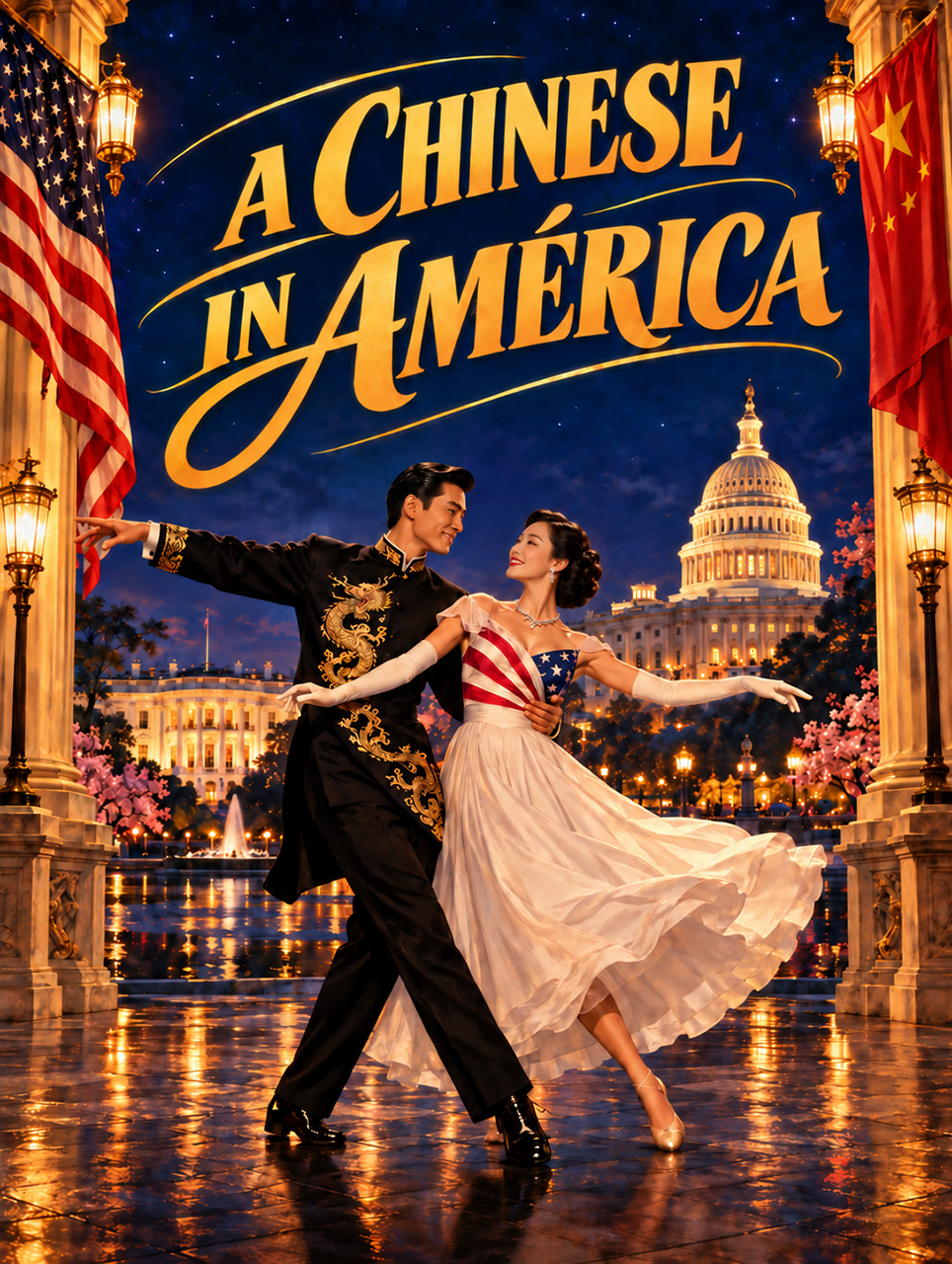
If Trump’s visit to Beijing allowed us to imagine a new version of An American in Paris, this sequel once again changes location and protagonist and becomes A Chinese in America. We do not yet know whether it will be a comedy of errors, a thriller or a commercial drama, but the cast looks promising.
On the table will be the tariff truce, rare earths, artificial intelligence and that red telephone for the age of algorithms which Washington apparently wants to build. In the past, the superpowers feared that human error might trigger a nuclear war. Now they fear that a machine might do so. It is difficult to know whether we have moved forwards or backwards.
Taiwan will also make an appearance: the actor who never features on the official posters but without whom the plot cannot be understood. Beijing will ask for fewer weapons, fewer visits and fewer words. Washington will offer more weapons and words—and perhaps fewer visits. Trump knows that Taiwan can serve as a bargaining chip. Xi knows that some currencies cannot be exchanged.
The Archives
The final act will take place at the National Archives. Trump and Xi will examine documents concerning the history of Sino-American relations. Perhaps the Treaty of Wangxia of 1844 will make an appearance, signed when a weakened China accepted conditions dictated by the West. For Beijing, every international visit also contains an excursion into history. Much has changed since then.
Xi is not travelling merely to discuss tariffs. He is travelling to demonstrate that China no longer appears before the United States, but stands opposite it. Trump, for his part, needs to prove that he can still close the great deal that no other president has managed to secure.
Both men want time: Trump, to approach the elections from a position of strength; Xi, to continue strengthening China. Both want stability, although each would prefer the other to be the one who remains still.
In the end, there will be handshakes, carefully ambiguous communiqués and smiles broad enough for the photographs. It will be said—people will say—that the visit was historic. All visits between China and the United States are historic, particularly when we still do not know what history they will ultimately write.
Gideon Rachman of the Financial Times has delivered a severe verdict on the matter: “But, unfortunately, the two leaders share many of the same flaws: narcissism, nationalism and narrow-mindedness. The world needs far-sighted leaders. And that is not what is on offer.”
Others say that they are the finest actors for the film of our time. We shall see what becomes of this A Chinese in America.