

Trump’s “panicans” are legion. The war against Iran is nothing more than a miscalculation.
“It was the stupidest thing this country has ever done.” The country was the United States, and the speaker was none other than Dan Kimball, Secretary of the Navy during the Truman administration.
It was hard to believe that, in the name of security, they deported to China Qian Xuesen, a prodigy trained at Caltech and MIT. After World War II, the Americans sent him to Germany to interrogate German scientists—including Wernher von Braun, who would later become the chief architect of the Saturn V rocket for NASA’s Apollo program—and recruit them for the U.S. missile program. Two years later, Qian was even granted permanent residency in the United States. By deporting him, America not only lost one of its best scientists, but handed China the mind that would drive its space and ballistic programs. “He was no more a communist than I was, and we forced him to go,” Kimball concluded.
Borders
Borders not only define the geographical and political limits of countries. They also establish abstract or conceptual limits—that is, they define the point up to which something remains reasonable. The war against Iran, beyond violating territorial boundaries, suggests it is also breaching the limits of what is conceptually reasonable.
So far, and without even counting the loss of life, the “Trump versus Iran” mission has driven up oil prices, shattered traditional alliances and consensus, and—something akin to shooting himself in the foot—has weakened his domestic political control at a particularly delicate moment.
Panicans
A few months ago, President Trump coined the neologism “panicans” to refer, in a derogatory way, to those who react with alarm to economic or geopolitical turbulence—people he described as “weak and stupid.”
However, the deterioration of the situation in the Middle East—marked by the assassination of Iranian leader Ali Larijani and the risk that even more radical factions could take control in Tehran—has revived precisely the kind of anxiety Trump criticized. In this context, his campaign promises to avoid new wars and reduce the cost of living for Americans are being undermined, eroding the political support that brought him back to power. Paradoxically, with this new conflict, he has broadened the scope of his own term, labeling as “panicans” not only situational critics but also anyone concerned about global political stability.
And as if that were not enough for the panicans, worried about both political and economic destabilization caused by this war, we should not forget that the United States has also temporarily lifted sanctions on the sale of Russian crude oil and other petroleum products that had already been loaded onto ships before March 12. This allows the release onto the market of around 100 million barrels of Russian oil, thus giving oxygen to the Kremlin’s war machine in Ukraine.
Is it about China?
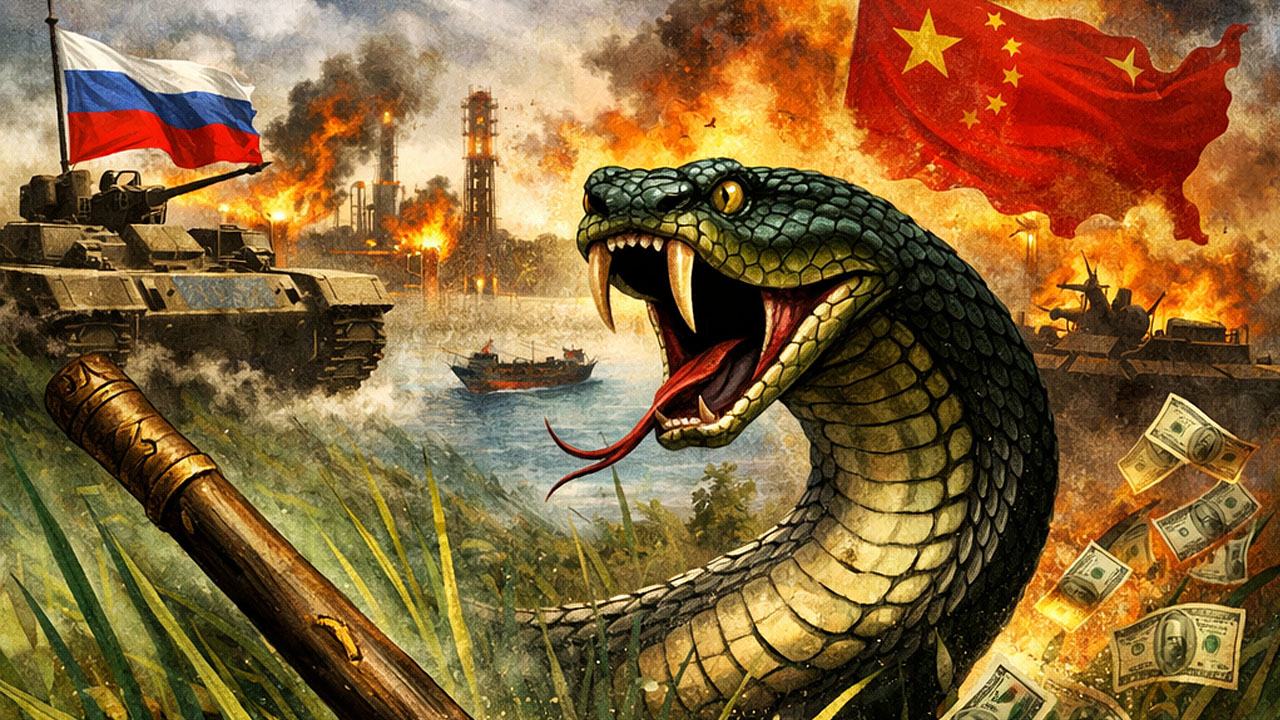
As is well known, China and Iran signed a 25-year Comprehensive Strategic Cooperation Agreement on March 27, 2021. It included cooperation in defense, though in a rather general and non-binding way. Moreover, the classic Chinese text The Thirty-Six Stratagems speaks of “beating the grass to scare the snake” (打草惊蛇, dǎ cǎo jīng shé). Could it be that this entire conflict has been orchestrated simply to frighten and weaken the Chinese “snake,” given that China imports about 15% of its oil from Iran, and to demonstrate that it is incapable of militarily protecting a partner that America deems undesirable?
The answer appears to be negative. Deporting Qian was a mistake (the stupidest thing), the Iraq war was likely another, and the war with Iran may well join the list—suggesting that everything has been a miscalculation beyond the borders.
____________________________________________
Originally published in the Ecuadorian newspaper El Comercio.